Monday, March 14, 2022

Differences among the major land revenue systems in British India i.e. Zamindari, Ryotwari and Mahalwari

Zamindari System (Permanent Land Revenue Settlement)

Thursday, March 10, 2022

Making Of The Indian Constitution: A Simplified Brief

Making of the Indian Constitution: a simplified brief

On the occasion of 70 years of the Constituent Assembly of India, Down to Earth explains the incremental stages of formulation of the Constitution


Salient features of the Constituent Assembly

making of indian constitutionThe Constituent Assembly of India sat for the first time on December 9, 1946. Thus started a historical journey which saw India attainting independence, deciding on its national flag, national insignia, national anthem; and ultimately adoption of the Constitution which made our country a democratic republic.  It is desirable that Constitution becomes accessible by common citizen and doesn’t just remain preserve of lawyers and scholars. We present this package with a hope that more and more people will realise that the Constitution is not a holy book but a functional manual.

SALIENT FEATURES OF CONSTITUENT ASSEMBLY OF INDIA

  • The Constituent Assembly of India came into existence as per the provisions of Cabinet Mission Plan of May 1946. Its task was to formulate constitution/s for facilitating appropriate transfer of sovereign power from British authorities to Indian hands.
  • The Assembly was to have proportional representation from existing provincial legislatures and from various princely states. Bulk of these elections was completed by the end of July 1946, under the supervision of Reforms Office under Governor General (Viceroy).
  • The Assembly was to have three sections: Punjab & North-West, Bengal-Assam and Rest of India. The Constitutions were to be formulated for Indian Union, each Section and for each of the Provinces therein. The Muslim League, which had won bulk of the 80 Muslim seats and dominated two smaller Sections, chose not to participate so the Assembly never convened separately in sections.
  • Assembly held 12 sessions, or rounds of sittings:
  1. December 9-23, 1946,
  2. January 20- 25, 1947,
  3. April 28- May 2, 1947,
  4. July 14- 31, 1947,
  5. August 14- 30, 1947,
  6. January 27, 1948,
  7. November 4, 1948-January 8, 1949,
  8. May 16- June 16, 1949,
  9. July 30-September 18, 1949,
  10. October 6-17, 1949,
  11. November 4-26, 1949,
  12. January 24, 1950.
  • Membership of the Assembly kept varying for different reasons, other than resignation and death. Many public figures showed keenness to enter the Assembly but its membership was also denounced by certain groups like Muslim League, Communists and Socialists. These attitudes changed too. After passage of the Indian Independence Act by British Parliament it was decided that those members who wish to retain their seats in provincial legislature would vacate their seats in the Assembly. But several members of provincial legislature continued to come and partake in the Assembly until the provision against this was made in the Constitution itself. Biggest change in membership was caused by the declaration of Partition of India. Certain members like Dr. Ambedkar, who were elected from territories assigned to Dominion of Pakistan, lost their seats. Muslim League members elected from United Provinces, Bihar and elsewhere came to occupy their seats after partition. Such members were humiliated on many occasions and Patel even told them to go to Pakistan. After initial disinterest, the princely states started negotiating with a committee of the Assembly for their representation. Over a period, hundreds of princely states were grouped into larger associations and provisions were made for them to elect their representatives to the Assembly. Till the last day of the Assembly, new members kept joining in. Hyderabad did not send any representative till the end. The total number of people who sat as members of the Assembly at any time has not been calculated by any official or scholar. Records show that maximum membership towards the end of tenure of Assembly was 307.
  • The Assembly took help of several non-members in formulation of the Constitution. Eminent public figures outside the Assembly were requested to work as members of committees formed by the Assembly for focused deliberations on specific features or segments.
  • Much of constitution-making took place in these committees, both from procedural and substantive viewpoint. Till date, no official report has appeared in public domain on the exact number of committees formed by the Constituent Assembly. Resolutions were moved for setting up committees as and when the need arose, and adopted after discussion. Depending on swiftness of nomination or election of members of respective committees, their formal appointment took few hours, days or weeks from the adoption of resolution.
  • Some of the known committees were:
  1. Organisational Committees

1.1- Rules of Procedure Committee

(appointed on December 11, 1946. 15 members, Chairperson- Rajendra Prasad, ex-officio. Worked till 20 Dec. 1946)

1.2- Steering Committee (appointed on January 21, 1947. 19 members, Chairperson- Rajendra Prasad, ex-officio. Worked till the end.)

1.3- Staff and Finance Committee (appointed on December 23, 1946. 11 members, Chairperson- Rajendra Prasad, ex-officio. Worked till the end.)

1.4- Credentials Committee (appointed on December 23, 1946. 5 members, Chairperson- A.K. Ayyar. Worked till the end.

1.5- Order of Business Committee (appointed on January 25, 1947. 3 members, Chairperson- K.M. Munshi. Worked till July 14, 1947)

1.6- States (Negotiating) Committee (appointed on December 21, 1946. 6 members, Chairperson- J.L. Nehru. Worked till June 5, 1947)

1.7- Flag Committee (appointed on June 23, 1947. 12 members, Chairperson- Rajendra Prasad, ex-officio. Worked till July 22, 1947)

1.8- Committee on Functions of Constituent Assembly, under the Indian Independence Act (appointed on August 20, 1947. 7 members, Chairperson- G.V. Mavlankar. Worked till August 25, 1947)

  1. Principal Committees and their sub-committees

2.1- Advisory Committee on Fundamental Rights, Minorities, Tribal Areas and Excluded Areas (appointed on 24 Jan. 1947. 57 members, Chairperson- Sardar Patel. Worked till 26 May 1949)

2.2- Union Powers Committee (appointed on 25 Jan, 1947. 12 members, Chairperson- J.L. Nehru. Worked till 26 Aug. 1947)

2.3- Union Constitution Committee (appointed on 4 May. 1947. 12 members, Chairperson- J.L. Nehru. Worked till 31 July, 1947.)

2.4- Provincial Constitution Committee (appointed on 4 May. 1947. 21 members, Chairperson- Sardar Patel. Worked till 21 July, 1947.)

2.5- Drafting Committee (appointed on 29 Aug. 1947. 8 members, Chairperson- Dr. Ambedkar. Worked till 17 Nov. 1949)

  1. Other Sectoral Committees

3.1- Ad-hoc Committee on Citizenship (appointed on 30 April, 1947. 7 members, Chairperson- S. Varadachariar. Worked till 12 July. 1947)

3.2- Committee on Chief Commissioner’s Provinces (appointed on 31 July, 1947. 7 members, Chairperson- N. Gopalaswami Ayyangar. Worked till 21 Oct. 1947)

3.3- Experts Committee on Financial Provisions of Constitution (appointed in Nov. 1947. 3 members, Chairperson- N.R. Sarkar. Worked between 17 Nov.- 5 Dec. 1947)

3.4- Sub-Committee on Minority safeguards for West Bengal and East Punjab (appointed on 24 Feb. 1948. 5 members, Chairperson- Sardar Patel. Worked till 23 Nov., 1948.)

  • Curiously, the so-called Special Committee was constituted to decide the future course of action after comments had arrived in response to the Draft Constitution of February 1948. Neither a resolution for its constitution existed, nor anybody cared to inform the Assembly later on how and why this committee of great consequence was formed. In all, 32 members attended meetings of Special Committee on April 10-11, 1948, which were chaired by JL Nehru.
  • Rajendra Prasad was the elected President of Constituent Assembly while VT Krishnamachari and HC Mookerji served as Vice-Presidents. HVR Iyengar was the secretary general of the Assembly, and SN Mukherji was the Chief Draftsman.
  • After authentication of copies of the Constitution, the Constituent Assembly got naturally dissolved with its Chairperson having been elected the President of India, and its staff diverted to other avenues. But bulk of the Assembly continued functioning as provisional Parliament of India till first general elections were held. Indeed the first amendment to the Constitution of India was made by this provisional Parliament in the summer of 1951.

Preparation of Memorandum

Making of Constitution has been a controversial issue for a long time. This controversy consumes much public energy that can better be utilised in improving our collective understanding of the Constitution. Many experts have written dedicated books on making of constitution but a simplified brief on incremental stages of its formulation was missing.

1. Dissemination of Constitutional Advisor's Brief (pamphlets) & Questionnaire (September 1946-November 1947)

B N Rau was appointed Constitutional Advisor by the-then Viceroy Lord Wavell to head the Constituent Assembly Secretariat sometime in late July 1946. He had retired from civil service in January 1944 but remained active. He offered his honorary services to the Viceroy, which was accepted most probably due to his stint in Reforms Office soon after the enactment of Govt. Of India Act 1935 Rau prepared number of pamphlets on various aspects of impending constitution and also collected text of some important constitutions of the world, to facilitate informed discussion by the members of Assembly. Jawaharlal Nehru, as vice-president of Viceroy’s Executive Council, approved dissemination of these briefs on September 16, 1946. Later on, Rau also circulated focused questionnaire on certain aspects of federal constitution in March 1947, and focused Notes to various committees on occasion.

2. Preparation of Memorandum by the Advisor based on responses; Submission of notes by certain members (February-November 1947)

Based on responses to his briefs and questionnaire, Rau prepared his Memorandum which included blueprints of probable provisions of impending constitution. Certain members chose to send their own individual notes which were to be placed before committees of the Assembly.

3. Deliberations in Principal Committees, including joint and sub-committees, and their Reports (February-August 1947)

In the second session of Assembly, its Chairman constituted four principal committees: Advisory Committee on Fundamental Rights, Minorities and Tribal Areas & Excluded Areas, Provincial Constitution Committee, Union Constitution Committee and Union Powers Committee. Of these committees, first two were chaired by Sardar Vallabhbhai Patel while the latter two were chaired by Nehru. Most of these committees appointed their sub-committees for more focused work on particular segment. Two or three of these committees also sat jointly to consider matters lying in overlapping zones of consideration. These committees finished bulk of their work by August 1947, but work of first committee went on for a long time on account of concerns of minorities. Partition is often cited as an excuse for delay but the crucial declaration was made on June 3, 1947 while these principal committees were tasked to finish their work by April-May 1947 itself. Anyway, their reports to Assembly included draft provisions of the constitution and some explanatory notes. Usually, the chairperson of the respective committee submitted the report to the President of Assembly, as also presented it in the Assembly and explained or defended it.

[Working of Constituent Assembly, including nomination of acting President, election of regular President and formation of operational committees was decided by an unofficial Experts’ Committee of Congress in July-August 1946. It was this committee which prepared the draft of Objective Resolution which was moved in the first session by Nehru.]

4. Discussion on Reports in Constituent Assembly and adoption of principles (April-Aug. 1947)

The Assembly discussed the reports of principal committees in detail and adopted the principles therein. More than two thirds of the final constitution Bill was covered in these discussions.

 5. Preparation of First Draft by Constitutional Advisor (July-October 1947)

Constitutional Advisor started putting together first draft of constitution by aligning the reports already discussed and adopted. He also augmented it by filling obvious gaps himself in the form of suggestions, or indicated certain spaces that would only be filled after reports of sectoral committees came in. This was the stage of first major delay in completion of work since the first draft missed the deadline of August-September and arrived only on October 27, 1947. 

Deliberations and recommendations

1. Deliberations in Sectoral Committees and their Reports (April-December 1947)

Various sectoral committees commenced and finished their deliberations, and this activity went on over a long period. These sectoral committees were assigned very definite tasks either by the Chairman of Assembly or by one of the committees itself. Many of these reports couldn’t be utilised in the first draft of constitutional advisor or in the Draft Constitution, and were incorporated in later stages.

2. Deliberations in Drafting Committee and resultant Draft Constitution (October 1947- February 1948)

Assembly had resolved in July 1947 to constitute a drafting committee which will attune the constitution Bill from the perspective of legislative language and other such aspects. On August 29, 1947 this drafting committee was elected by the Assembly, while the committee chose its Chairman in its first meeting. Primary contribution of drafting committee was refining and expanding the draft of constitutional advisor (240 Articles, 13 Schedules) in its sitting held almost continuously. It produced the draft constitution by February 21, 1948 which contained 315 Articles and 8 Schedules. It was published on February 26 and circulated widely among official and non-official circles, to elicit comments. This was second major stage of delay in formulation of constitution since it was supposed to finish its work in a month and Dr. Ambedkar even informed midway through this round of sittings that assigned work would be finished within December 1947.

3. Consideration of Responses by Drafting Committee, and its recommendations (March 23, 24 and 27, 1948)

Responses were invited on draft constitution by March 22, 1948. Soon, thereafter, the drafting committee sat down to consider these responses as presented by the assembly secretariat. Recommendations emanating from these sittings were duly forwarded to the Chairman of Assembly.

4. Deliberations on Responses in Special Committee, and its decisions (April 10-11, 1948)

Chairman of Assembly decided that responses on draft constitution and recommendations of drafting committee should be considered by a Special Committee, which was to consist of members of Committees on Union Powers, Union Constitution and Provincial Constitution. Nehru chaired the sittings attended by some 30 members. This Committee resolved some matters and held over some of them for later consideration. It recommended that call for amendments from members of Assembly may be issued. This Committee was supposed to reconvene on May 11, 1948 but apparently, it never did. It remains a mystery, unanswered by any participant or scholar, as to what caused the official inactivity on formulation of Constitution for six long months.

5. Deliberations in Drafting Committee for parallel/official amendments (October 18-20, 1948)

Finally on October 18, 1948 the drafting committee picked the cue and decided in its sittings over three days that a reprint of draft constitution will be issued containing the amendments that the committee was willing to sponsor, parallel to relevant Article or Schedule. Approach taken at these two stages ensured that the Assembly would have to go through discussion and voting again and again on several segments. Lack of clarity and interest shown by Nehru and Patel in this phase expanded the role and authority of the Drafting Committee. Neither of the two de-facto leaders of the Assembly came forward to get a proper second draft prepared and to steer it in the Assembly. 

6. Publication of bound books of proposed amendments, both officially sponsored and private member's amendments (October 26, 1948)

As per the resolution of the drafting committee, a reprint of draft constitution was issued to all members of the Assembly. Critique of the rationale behind this strange draft has been consistently avoided, and thus, it remains out of print despite the fact that the Assembly considered this version and not the oft-cited Draft Constitution of February 1948. Simultaneously, the President of the Assembly ensured printing and distribution of bound volumes of amendments proposed by individual members. During the course of debates in the Assembly, amendments were referred to by sequential number and book number.

Final voting

1. Discussions and voting in meetings of Congress Assembly Party, held in Constitution House (October 1948-November 1949)

Since the Assembly was dominated by representatives from the Congress, party whip played a great role. However, certain individual members did express their views in Assembly, even at the risk of challenging the party whip. The Assembly Party meetings were open to non-congressmen who cared to attend. The Party took care not to enforce strict discipline on emotional issues and allowed open discussion in the Assembly, though in the end final decision on almost every segment of constitution was taken herein. The Constitution Bill being such a bulky document, the party whip issued to all members mimeographed lists of Articles and the decisions taken thereon. 

2. Discussion and voting on Draft Constitution and amendments, in the Assembly (November 4, 1948 –October 17, 1949)

Most visible part of constitution-making was the year-long discussions in Assembly. For official purposes, this was called the first-reading. The discussion wasn’t always conducted in sequential order that articles were arranged in the draft constitution but was decided by the Steering Committee. Very few unofficial amendments were accepted by the Assembly at the voting. Even if they are not withdrawn, they were often negated. Some of the unofficial amendments were accepted by the Drafting Committee during discussion and thus, they were not voted upon. KM Munshi played a crucial role of a regular link between the Drafting Committee and the Congress Assembly Party.

3. Preparation of so-called Final Draft, by Drafting Committee (November 3, 1949)

Discussion in the Assembly was rather haphazard insofar not being in sequential order of the Draft Constitution. Several matters, already decided after discussion and voting, were revisited for deliberations and often, changes of drafting nature were left to the Drafting Committee. It was obvious that a clean draft was required and therefore, the Drafting Committee submitted such a draft. In doing so, certain unapproved changes were introduced by the committee which required deliberation and decision of the Assembly. Individual members received it around November 6, 1949 and were given opportunity to propose amendments to these new changes.

4. Discussion for three days and final voting for amendment of certain clauses (November 14-16, 1949)

Officially called the second-reading of constitution Bill, this phase witnessed 170 amendments being moved. Only 88 were accepted, 30 withdrawn and 52 negated. With this, the real work of formulation of Constitution got over.

5. Discussion on ‘settled-by-Assembly’ version of Constitution Bill (November 17-26 1949)

This was a beginning of a largely ceremonial phase, officially called third-reading. In the discussion that ensued, most of the speakers (more than 100) explain their take on merits and shortcomings of the Constitution. Dr Ambedkar and the President of the Assembly gave their views in the end.

6. Final adoption, enactment through signing by Chairman of Assembly; and partial commencement (November 26, 1949)

With the last voting on the Constitution, it was adopted by the Constituent Assembly. The President of the Assembly signed a copy of the Constitution to officially bring it in force, although partially, because only 16 of the 395 Articles came into force at that point in time.

7. Signing of calligraphed version of the Constitution by all members of Assembly (January 24, 1950)

Proceedings of the day began by the declaration of the President of the Assembly having been elected as the President of India. Then, all members signed three copies, the English print version and calligraphed version in English and Hindi, of the Constitution. Nehru was the first and Prasad was the last to sign these copies.

8. Formal Commencement (January 26, 1950)

As per the provisions in the Constitution, it formally commenced on January 1950, bringing it in force in its entirety. This date was most probably chosen to commemorate the declaration of ‘Poorna Swaraj’ (Total Independence) by Nehru at an annual session of the Congress in Lahore in 1929. This day was used to be celebrated as Independence Day by the Congress for many years but circumstances (and the sudden decision of British authorities to grant independence) made it Republic Day.


Wednesday, March 9, 2022

भारत में यूरोपीय कंपनियों का आगमन


भारत में यूरोपीय कंपनियों का आगमन 


भारत में यूरोपीय कंपनियों का आगमन का क्रम

पुर्तगालियों का आगमन

15th शताब्दी के बाद से ही पुर्तगाली अफ्रीका के रास्ते से भारत का रास्ता ढूंढ रहे थे | पुर्तगाली भारत में सबसे पहले आने वाले यूरोपीय थे | पुर्तगाल का वास्कोडिगामा 1497 अफ्रीका के पश्चिमी तट से शुरुआत करते हुए भारत को ढूंढने निकला | वह दक्षिण अफ्रीका के केप ऑफ गुड होप से होते हुए पूर्वी अफ्रीका में भारतीय गुजराती व्यापारियों की सहायता से अरब सागर होते हुए सर्वप्रथम 1498 भारत पहुंचा |

पुर्तगाली नाविक वास्कोडिगामा सर्वप्रथम भारत 1498 केरल के कालीकट में पहुंचा | उस समय कालीकट की राजा जमोरिन हुआ करते थे | शुरुआत में पुर्तगालियों के प्रतिद्वंदी व्यापारी अरब थे, क्योंकि अरब पहले से ही भारत के साथ व्यापार करते थे | और ऑटोमन साम्राज्य के समय यूरोप में भारतीय मसाले अरब लोग ही पहुंचाते थे |

 शुरुआत में पुर्तगालियों ने भारत के साथ व्यापार शुरू किया तो उन्होंने अरब लोगों पर, उनके नावों पर बहुत सारे हमले किए | और भारत के साथ अरब के व्यापार को खत्म करवा के पुर्तगालियों ने कालीकट, कन्नूर और कोच्चि में अपनी फैक्ट्रियां खोली |

1505 में फ्रांसिस्को डी अल्मोड़ा भारत में पहला पुर्तगाली गवर्नर बन कर आया | अल्मोड़ा ने नीले पानी की नीति (Blue Water Policy) अपनाई जिसके तहत समुद्र से व्यापार करने के लिए पुर्तगालियों से आज्ञा (Permission) लेनी पड़ती थी | इसे कार्टाज सिस्टम भी कहा जाता था |अल्मोड़ा के बाद भारत में अल्बूकर्क पुर्तगाली गवर्नर बना | अल्बुकर्क ने 1510 में बीजापुर के सुल्तान से गोवा को प्राप्त कर लिया | 1526 में पुर्तगालियों ने मंगलोर पर भी कब्जा कर लिया | अल्बूकर्क को भारत में पुर्तगाली साम्राज्य का वास्तविक संस्थापक माना जाता है |

1529 में नीनो डी कुन्हा भारत में पुर्तगाली गवर्नर बना और 1530 में पुर्तगालियों ने अपनी राजधानी कोच्चि से गोवा स्थानांतरित कर ली |

पुर्तगालियों ने 1538 में दीव पर कब्जा किया, जो 1961 तक रहा | गोवा में पुर्तगालियों ने ईसाई संत फ्रांसिस जेवियर के नेतृत्व में लोगों के धर्म परिवर्तन करना चाहा |

200 वर्षों के दौरान पुर्तगालियों ने लगभग पूरे भारत के समुद्र तट पर कब्जा कर लिया था, लेकिन फिर भी यह अंग्रेजों से ज्यादा ताकतवर नहीं बन पाए इसके प्रमुख कारण ही निम्न है –

  • पुर्तगालियों ने समुद्री तटों के अलावा जमीन पर या भारत के अंदर कभी ताकत हासिल नहीं की |
  • पुर्तगाली धार्मिक कट्टर थे, इस कारण से स्थानीय लोगों में यह लोकप्रिय नहीं बन पाए |
  • प्रशासन में भ्रष्टाचार के कारण कंपनी आगे नहीं बढ़ पाई |
  • पुर्तगाल के पास में संसाधनों की कमी थी तथा वह स्पेन के अधीन हो चुका था |

डचों का आगमन

सर्वप्रथम कॉर्नेलिस हाउटमेन 1596 में भारत आने वाला पहला डच व्यक्ति था | 1602 में “यूनाइटेड ईस्ट इंडिया कंपनी ऑफ नीदरलैंड” अस्तित्व में आई |

1605 में डचों ने सबसे पहले मसूलिपटनम (आंध्र प्रदेश) में फैक्ट्री स्थापित की उसके बाद इन्होंने कालीकट और सूरत में भी फैक्ट्री स्थापित की | अंग्रेज और फ्रांस से प्रतिस्पर्धा के कारण शुरुआत से ही डचों का ध्यान दक्षिण पूर्वी एशियाई देशों पर रहा |1759 में वेदरा की लड़ाई में ईस्ट इंडिया कंपनी से हारने के बाद भारत में सीमित हो गए और उनका व्यापार इंडोनेशिया की तरह ज्यादा हो गया |


ईस्ट इंडिया कंपनी का आगमन

1599 ईस्ट इंडिया कंपनी की स्थापना की गई जिसे 1600 में महारानी एलिजाबेथ प्रथम ने रॉयल चार्टर के द्वारा पूर्व (भारत, दक्षिण-पूर्व एशियाई, पूर्वी अफ्रीका, आदि) से व्यापार करने का एकाधिकार दे दिया |

1608 में ईस्ट इंडिया कंपनी ने अपना राजदूत विलियम हॉकिंस को जहांगीर के दरबार में सूरत में फैक्ट्री खोलने की आज्ञा के लिए भेजा | 1612 में सुवाली के युद्ध में ईस्ट इंडिया कंपनी ने पुर्तगालियों को हरा दिया और 1613 में जहांगीर की अनुमति से सूरत में अपनी पहली फैक्ट्री स्थापित की |ईस्ट इंडिया कंपनी ने 1611 में मसूलीपट्टनम में अपनी पहली व्यापारिक कोठी (Trading Post) स्थापित की थी |जेम्स प्रथम की राजदूत टॉमस रो को जहांगीर के दरबार में राजदूत के रूप में भेजा गया, जिसने अन्य जगह पर फैक्ट्रियों खोलने की अनुमति प्राप्त की | ईस्ट इंडिया कंपनी को 1668 में ब्रिटिश सरकार द्वारा, पुर्तगालियों से दहेज में प्राप्त मुंबई प्राप्त हुआ |

1690 में जॉब चरनॉक ने सुतानती में एक फैक्ट्री की स्थापना की और 1698 सुतानती, कालीकट और गोविंदपुर नामक तीन गांवों की जागीरदारी प्राप्त की, बाद में यही काम कोलकाता के रूप में विकसित हुए | 1700 में सुतानती की किलेबंदी की गई और इसका नाम फोर्ट विलियम रखा गया |

1717 में ईस्ट इंडिया कंपनी ने मुगल सम्राट फर्रूखसियर से दस्तक व्यापार पत्र प्राप्त कर लिया, जिसकी सहायता से यह बिना किसी रोक-टोक के व्यापार कर सकते थे |

ईस्ट इंडिया कंपनी ने 1757 में प्लासी के युद्ध में बंगाल के नवाब सिराजुद्दोला को हराया और मीर जाफर को बंगाल का नवाब बनाया गया |

7 वर्ष बाद, 1764 में बक्सर के युद्ध में अंग्रेजो ने मुगल सेना, अवध के नवाब और बंगाल के नवाब मीर कासिम तीनों की सेना को हरा दिया और भारत में अपनी जड़ें मजबूत कर दी | बक्सर के युद्ध के बाद 1765 में इलाहाबाद की संधि के द्वारा ईस्ट इंडिया कंपनी को बंगाल बिहार और उड़ीसा का शासन और व्यापार की छूट प्राप्त हो जाती है |

व्यापार के उद्देश्य से भारत में आई ईस्ट इंडिया कंपनी ने 1947 तक भारत पर शासन किया, 


डेनिश का भारत में आगमन

डेनमार्क की ईस्ट इंडिया कंपनी की स्थापना 1616 में की गई थी | व्यापार के उद्देश्य से यह भी भारत में आए और उन्होंने 1620 में ट्रेंकुबार (तमिलनाडु) में सबसे पहले अपनी फैक्ट्री स्थापित की | 1676 में सेरामपुर (बंगाल) में मुख्यालय स्थापित किया |

अंग्रेजों के बढ़ते दबदबे के कारण 1845 में अपने व्यापार ईस्ट इंडिया कंपनी को बेच कर भारत छोड़कर चली गई |


फ्रांसीसीयों का आगमन

भारत में सबसे अंतिम यूरोपीय आने वाली शक्ति फ्रांसीसी थी | फ्रांस के सम्राट लुई 14वे के मंत्री कॉलबर्ट ने 1664 में फ्रेंच ईस्ट इंडिया कंपनी की स्थापना की थी |

फ्रांसीसी ने 1667 में सूरत में अपनी पहली फैक्ट्री स्थापित की थी | फ्रांसिस मार्टिन ने 1673 में पांडिचेरी की स्थापना की थी |1740 में डुप्ले फ्रांसीसी गवर्नर बन कर भारत में आया | परंतु उसे भी ईस्ट इंडिया कंपनी से हार का सामना करना पड़ा, जिसकी चर्चा हम आगे करेंगे | 1760 में वांडीवाश की लड़ाई के बाद फ्रांसीसीयों का अस्तित्व सीमित हो गयाl


कर्नाटक युद्ध

ब्रिटिश एवं फ्राँसीसी व्यापारिक उद्देश्यों के लिये भारत आए लेकिन वे अंततः भारत में राजनीतिक वर्चस्व स्थापित करने में लिप्त हो गए।

  • दोनों की दृष्टि इस क्षेत्र में राजनीतिक शक्ति स्थापित करने पर थी।
  • भारत में एंग्लो-फ्रेंच प्रतिद्वंद्विता ने इतिहास में इंग्लैंड एवं फ्राँस की पारंपरिक प्रतिद्वंद्विता को प्रतिबिंबित किया।
  • विशेष रूप से भारत में तीन कर्नाटक युद्धों के रूप में एंग्लो-फ्रेंच प्रतिद्वंद्विता ने एक बार फिर तय कर लिया कि संपूर्ण भारत में शासन स्थापित करने के लिये फ्राँसीसी अंग्रेज़ों से अधिक उपयुक्त नहीं थे।

प्रथम कर्नाटक युद्ध (1740-48)

पृष्ठभूमि:

  • कोरोमंडल तट एवं इसके आतंरिक इलाकों को ‘कर्नाटक’ नाम यूरोपियों द्वारा दिया गया था।
  • प्रथम कर्नाटक युद्ध यूरोप के एंग्लो-फ्राँसीसी युद्ध का विस्तार था जो ऑस्ट्रियाई उत्तराधिकार के लिये हुआ था।
  • प्रथम कर्नाटक युद्ध को सेंट थोम (St. Thome) के युद्ध के रूप में जाना जाता है, जो फ्राँसीसी सेनाओं एवं कर्नाटक के नवाब अनवर-उद-दीन (Anwar-ud-din) की सेनाओं के मध्य लड़ा गया था, अनवर-उद-दीन से अंग्रेज़ों ने सहायता की अपील की थी।

ऑस्ट्रियाई उत्तराधिकार के लिये युद्ध

  • वर्ष 1740-1748 के मध्य यूरोप की अधिकांश महान शक्तियाँ मारिया थेरेसा (Maria Theresa’s) के ऑस्ट्रियाई हैब्सबर्ग (Austrian Habsburg) राजवंश के उत्तराधिकार के मुद्दे के कारण संघर्षरत थीं।
    • इस युद्ध में फ्राँस, प्रशिया, स्पेन, बवेरिया के साथ पूरा यूरोप शामिल था और सैक्सनी ने ऑस्ट्रिया और ब्रिटेन के खिलाफ प्रदर्शन किया।
    • प्रथम साइलेशियन युद्ध (1740–42) एवं द्वितीय साइलेशियन युद्ध (1744–45) युद्ध की ये दो शृंखलाएँ ऑस्ट्रिया एवं प्रशिया के आसपास केंद्रित थीं।
    • तीसरा युद्ध भारत एवं उत्तरी अमेरिका में औपनिवेशिक अधिकारों के लिये फ्राँस तथा ब्रिटेन के मध्य चल रहे संघर्ष पर केंद्रित था।
      • युद्ध के दौरान ब्रिटिश सेनाओं ने अपनी सैन्य दक्षता को सिद्ध किया।
  • अक्तूबर 1748 में हस्ताक्षरित ऐक्स-ला-चैपल (Aix-la-Chapelle) की शांति संधि के साथ यह युद्ध समाप्त हुआ।
    • इस संधि के तहत फ्राँस ने लुईसबर्ग पर अपने अधिकार के बदले में ऑस्ट्रियाई नीदरलैंड पर अधिकार छोड़ने तथा ब्रिटेन को मद्रास वापस देने पर सहमति व्यक्त की।
    • मारिया थेरेसा को भी ऑस्ट्रिया के शासक के रूप में मान्यता मिल गई थी।

युद्ध के कारण:

  • यद्यपि फ्राँस, भारत में अपनी अपेक्षाकृत कमजोर स्थिति के प्रति सचेत था, उसने भारत में युद्ध के विस्तार का समर्थन नहीं किया लेकिन कमोडोर कर्टिस बेनेट (Commodore Curtis Bennett) के नेतृत्व में अंग्रेज़ी नौ-सेना ने फ्राँस को उकसाने के लिये कुछ फ्राँसीसी जहाज़ों को ज़ब्त कर लिया।
    • फ्राँसीसी गवर्नर जनरल मार्क्विस जोसेफ-फ्राँस्वा डुप्लेक्स ने कर्नाटक के नवाब से सुरक्षा की अपील की और बदले में कर्नाटक के नवाब ने अंग्रेज़ों को चेतावनी दी कि उसका राज्य तटस्थ है और फ्राँसीसी अधिकृत क्षेत्र पर किसी भी हमले को बर्दाश्त नहीं किया जायेगा।
  • इसके बदले में फ्राँस ने मॉरीशस के फ्राँसीसी गवर्नर एडमिरल ला बोरडोनाइस के नेतृत्व में मॉरीशस के जहाज़ी बेड़े, फ्राँस के टापू (Isle of France) की मदद से वर्ष 1746 में मद्रास पर कब्ज़ा कर लिया।
    • मद्रास पर कब्ज़ा करने से डुप्लेक्स एवं ला बोरडोनाइस के मध्य एक गंभीर वाद-विवाद शुरू हो गया।
      • डुप्लेक्स नवाब की तटस्थता के आदेश की अवहेलना  के लिये मुआवज़े के रूप में शहर को नवाब को सौंपना चाहता था, जबकि ला बोरडोनाइस (La Bourdonnais) शहर को पुनः अंग्रेज़ों को सौंपना चाहता था।
    • यह विवाद लंबे समय तक चलता रहा, अंततः अनवर-उद-दीन ने हस्तक्षेप करने का निर्णय लिया। उसने मद्रास में फ्राँसीसियों को घेरने के लिये अपने पुत्र महफूज़ खान (Mahfuzz Khan) के नेतृत्व में 10,000 सैनिकों की एक सेना भेजी।

परिणाम:

  • सेनापति पैराडाइज़ (Captain Paradise) के नेतृत्व वाली एक छोटी फ्राँसीसी सेना ने अड्यार नदी (River Adyar) के तट पर सेंट थोम में महफूज़ खान के नेतृत्व वाली मज़बूत भारतीय सेना को हरा दिया।
  • ऐक्स-ला-चैपल की शांति संधि पर हस्ताक्षर होने के बाद ऑस्ट्रियाई  उत्तराधिकार के युद्ध को एक निष्कर्ष तक लाने के पश्चात् प्रथम कर्नाटक युद्ध वर्ष 1748 में समाप्त हो गया।
    • इस संधि की शर्तों के तहत मद्रास को पुनः अंग्रेज़ों को सौंप दिया गया और बदले में फ्राँसीसियों को उत्तरी अमेरिका में अपने क्षेत्र पुनः प्राप्त हो गए।

महत्त्व:

  • इस युद्ध ने भारत में यूरोपियों की आँख खोल दी: इस युद्ध ने स्पष्ट कर दिया कि एक छोटी अनुशासित सेना भी बहुत बड़ी भारतीय सेना को आसानी से पराजित कर सकती है।
  • इसके अतिरिक्त इस युद्ध ने दक्कन में एंग्लो-फ्राँसीसी संघर्ष में नौ-सेना बल के महत्त्व को उजागर कर दिया।

द्वितीय कर्नाटक युद्ध (1749-54)

पृष्ठभूमि:

  • द्वितीय कर्नाटक युद्ध की नींव भारत में एंग्लो-फ्रेंच प्रतिद्वंद्विता के कारण रखी गई थी।
  • प्रथम कर्नाटक युद्ध की समाप्ति के पश्चात् भी भारत में दीर्घावधि तक शांति नहीं रही।
    • वर्ष 1748 में दक्कन के मुगल गवर्नर एवं हैदराबाद के अर्द्ध-स्वतंत्र नवाब निज़ाम-उल-मुल्क की मृत्यु हो गई।
    • निज़ाम की मृत्यु के पश्चात् उत्तराधिकार के लिये संघर्ष आरंभ हो गया तथा ब्रिटिश एवं फ्राँसीसी दोनों ने इस पर अपनी उम्मीदवारी प्रस्तुत की जो कि विवाद का कारण बन गया।
      • फ्राँसीसी गवर्नर डुप्लेक्स जो कि प्रथम कर्नाटक युद्ध में सफलतापूर्वक फ्राँसीसी सेना का नेतृत्व कर चुका था, ने अंग्रेज़ों को हराने के लिये स्थानीय राजवंशीय विवादों में दखल देकर दक्षिण भारत में अपनी शक्ति एवं फ्राँसीसी राजनीतिक प्रभाव बढ़ाने का प्रयास किया।
  • परिणामस्वरूप द्वितीय कर्नाटक युद्ध वर्ष 1749 से 1754 तक चला एवं अंग्रेज़ों ने दक्षिण भारत में अपनी स्थिति मज़बूत की।

युद्ध के कारण:

  • यह अवसर वर्ष 1748 में हैदराबाद के स्वतंत्र राज्य के संस्थापक निज़ाम-उल-मुल्क की मृत्यु एवं उसी वर्ष कर्नाटक के नवाब दोस्त अली के दामाद चंदा साहिब की मराठाओं  द्वारा रिहाई से उत्पन्न हुआ।
  • हैदराबाद में निज़ाम के पुत्र नासिर जंग को हैदराबाद की राजगद्दी पर बैठाने का नवाब के प्रपौत्र मुज़फ्फर जंग ने विरोध किया था, उसने यह कहते हुए हैदराबाद की राजगद्दी पर अपना दावा पेश किया कि मुगल सम्राट ने उसे हैदराबाद के गवर्नर के रूप में नियुक्त किया था।
  • इसके अतिरिक्त दक्षिण में कर्नाटक के नवाब पद के दो उम्मीदवार थे, यह एक सहायक पद था जो आधिकारिक रूप से निज़ाम पर निर्भर था।
  • निज़ाम-उल-मुल्क को प्रांत में व्यवस्था बहाल करने के लिये हस्तक्षेप करने हेतु  बाध्य करने के पश्चात् अनवर-उद-दीन को वर्ष 1743 में कर्नाटक का नवाब नियुक्त किया गया था।
    • अनवर-उद-दीन निज़ाम के अधिकारियों में से एक था।
    • अनवर-उद-दीन की नियुक्ति पर चंदा साहब को नाराज़गी थी।
    • चंदा साहब कर्नाटक के एक पूर्व नवाब, दोस्त अली (1732-39) का दामाद था।
      • वर्ष 1741 में मराठों द्वारा त्रिचिनोपोली (Trichinopoly) में घेर लिये जाने से पहले वह फ्राँसीसियों का एक प्रभावी सहयोगी था।
  • फ्राँसीसियों ने दक्कन एवं कर्नाटक में क्रमशः मुजफ्फर जंग तथा चंदा साहिब के दावों का समर्थन किया, जबकि अंग्रेज़ों ने नासिर जंग व अनवर-उद-दीन का साथ दिया।

युद्ध का परिणाम:

  • मुज़फ्फर जंग, चंदा साहिब एवं फ्राँसीसियों की संयुक्त सेना ने वर्ष 1749 में अंबूर के युद्ध (वेल्लोर के पास) में अनवर-उद-दीन को पराजित कर उसकी हत्या कर दी।
    • नवाब युद्ध में मारा गया और अपने पुत्र मोहम्मद अली को नवाब की दावेदारी हेतु वारिस के रूप में छोड़ गया।
  • मुज़फ्फर जंग को हैदराबाद के निज़ाम एवं दक्कन के सूबेदार के रूप में पदारूढ़ किया गया तथा डुप्लेक्स को कृष्णा नदी के दक्षिण में स्थित सभी मुगल क्षेत्रों का गवर्नर नियुक्त किया गया।
    • पुद्दुचेरी के आस-पास के क्षेत्र एवं उड़ीसा तट (मसूलीपत्तनम सहित) पर भी कुछ क्षेत्र फ्राँसीसियों को सुपुर्द किये गए।
    • हालाँकि कुछ महीने बाद मुज़फ्फर जंग की हत्या कर दी गई एवं फ्राँसीसियों ने मुज़फ्फर जंग के चाचा सलाबत जंग को नए निज़ाम के रूप में पदारूढ़ कर दिया।
  • ईस्ट इंडिया कंपनी के रॉबर्ट क्लाइव ने (बंगाल प्रेसीडेंसी के प्रथम ब्रिटिश प्रशासक) त्रिचिनोपोली में मोहम्मद अली को प्रभावी सहायता प्रदान करने में विफल रहने के पश्चात् उसके समक्ष मद्रास के गवर्नर सॉन्डर्स पर डायवर्जन आक्रमण (Diversionary Attack) करने का प्रस्ताव रखा।
    • उसने त्रिचिनोपोली पर सैन्य दबाव को हटाने के लिये अर्कोट (कर्नाटक की राजधानी) पर अचानक छापामार आक्रमण का सुझाव दिया जिसमें अंग्रेज़ जीत गए।
    • कई युद्ध लड़ने के पश्चात् मोहम्मद अली ने चंदा साहिब की हत्या कर दी और बाद में कर्नाटक का नवाब बना।

परिणाम:

  • डुप्लेक्स की नीति के कारण फ्राँसीसी प्राधिकारी भारी वित्तीय घाटे के चलते  परेशान थे, अतः वर्ष 1754 में उसे वापस बुलाने का निर्णय लिया गया।
  • भारत में फ्राँसीसी गवर्नर-जनरल के रूप में चार्ल्स रॉबर्ट गोदेहेउ (Charles Robert Godeheu) ने डुप्लेक्स का स्थान ग्रहण किया।
  • गोदेहेउ ने अंग्रेज़ों के साथ बातचीत की नीति अपनाई और उनके साथ पुद्दुचेरी संधि पर हस्ताक्षर किये, जिसके तहत अंग्रेज़ एवं फ्राँसीसी देशी रियासतों के झगड़ों में हस्तक्षेप न करने पर सहमत हुए।
    • इसके अतिरिक्त प्रत्येक पक्ष द्वारा संधि के समय के अपने अधिकृत क्षेत्रों की स्थिति बहाल की गई थी।

निहितार्थ:

  • यह स्पष्ट हो गया कि यूरोपीय सफलता के लिये भारतीय सत्ता का सहयोग आवश्यक नहीं था बल्कि भारतीय सत्ता स्वयं यूरोपीय समर्थन पर निर्भर होती जा रही थी।
  • कर्नाटक में मोहम्मद अली एवं हैदराबाद में सलाबत जंग एक-दूसरे के संरक्षक के बजाय प्रतिद्वंदी बन गए।

तृतीय कर्नाटक युद्ध अथवा वांडिवाश का युद्ध (1758-63)

पृष्ठभूमि:

  • यूरोप में जब ऑस्ट्रिया ने वर्ष 1756 में सिलेसिया को पुनर्प्राप्त करना चाहा तो सप्तवर्षीय युद्ध (1756-63) शुरू हो गया।
    • ब्रिटेन एवं फ्राँस पुनः एक-दूसरे के आमने-सामने आ गए।

भारत में युद्ध का क्रम:

  • वर्ष 1758 में फ्राँसीसी जनरल, काउंट थॉमस आर्थर डी लैली के नेतृत्व में फ्राँसीसी सेना ने अंग्रेजों के किलों, सेंट डेविड एवं विजयनगरम पर कब्ज़ा कर लिया।
  • अंग्रेज़ काफी आक्रामक हो गए थे एवं उन्होंने मसूलीपत्तनम में एडमिरल डीएच (Admiral D’Ache) के नेतृत्व में फ्राँसीसी बेड़े (French Fleet) को भारी नुकसान पहुँचाया।

वांडिवाश का युद्ध:

  • तीसरे कर्नाटक युद्ध का निर्णायक युद्ध 22 जनवरी, 1760 को तमिलनाडु के वांडिवाश (या वांडावासी) में अंग्रेज़ों द्वारा जीता गया था।
    • अंग्रेज़ जनरल आइरे कोटे (General Eyre Coote) ने काउंट डी लैली (Count de Lally) के नेतृत्व वाली फ्राँसीसी सेना को बुरी तरह पराजित कर दिया एवं मार्क्विस डी बुसी (Marquis de Bussy) को बंदी बना लिया।
  • 16 जनवरी, 1761 को आत्मसमर्पण किये जाने से पूर्व आठ महीने तक लैली द्वारा वीरतापूर्वक पुद्दुचेरी की रक्षा की गई थी।
    • पुद्दुचेरी, जिंजी (Gingee) और माहे पर अपना वर्चस्व खो देने के पश्चात् भारत में फ्राँसीसी शक्ति अपने निम्नतम स्तर पर पहुँच गई थी।
  • लैली को युद्धबंदी के रूप में लंदन ले जाने के पश्चात् फ्राँस के सुपुर्द कर दिया गया जहाँ उसे कैद किया गया एवं वर्ष 1766 में मृत्युदंड दे दिया गया।

परिणाम एवं महत्त्व:

  • तृतीय कर्नाटक युद्ध निर्णायक साबित हुआ।
  • तृतीय युद्ध पेरिस शांति संधि (1763) के साथ समाप्त हुआ, जिसके तहत पुद्दुचेरी एवं चंदन नगर पुनः फ्राँस को सुपुर्द किये गए लेकिन वह उन क्षेत्रों में केवल व्यापारिक गतिविधियाँ ही कर सकते थे।
    • हालाँकि संधि ने भारत में फ्राँसीसी कारखानों को बहाल कर दिया, लेकिन युद्ध के बाद फ्राँसीसी राजनीतिक प्रभाव समाप्त हो गया।
  • इसके पश्चात् फ्राँसीसी, भारत में अपने समकक्षों पुर्तगाली एवं डच की तरह छोटे परिक्षेत्रों तथा वाणिज्य तक ही सीमित रहे।
  • भारतीय उपमहाद्वीप में ब्रिटिश सर्वोच्च यूरोपीय शक्ति बन गई।

निष्कर्ष

  • वांडिवाश की विजय के बाद ईस्ट इंडिया कंपनी का भारत में कोई यूरोपीय प्रतिद्वंद्वी नहीं रहा। इस प्रकार वे संपूर्ण देश पर शासन करने के लिये तैयार थे।
  • गौरतलब है कि वांडिवाश के युद्ध में दोनों सेनाओं में भारतीय लोगों ने सिपाहियों के रूप में अपनी सेवाएँ दीं।
  • इससे पता चलता है कि चाहे जो भी पक्ष जीता हो, यूरोपीय आक्रमणकारियों द्वारा भारत का पतन अवश्यंभावी था।

अंग्रेज़ों की विजय एवं फ्राँसीसियों की हार के कारण

  • ब्रिटिश पक्ष पर कम सरकारी नियंत्रण: ईस्ट इंडिया कंपनी एक निजी उद्यम थी।
    • इससे लोगों में उत्साह एवं आत्मविश्वास की भावना उत्पन्न हुई।
      • इस पर कम सरकारी नियंत्रण होने के कारण कंपनी सरकार के अनुमोदन की प्रतीक्षा किये बिना तत्काल निर्णय ले सकती थी।
    • वहीं फ्राँसीसी कंपनी राज्य की एक व्यापारिक संस्था थी।
      • इसे फ्राँसीसी सरकार द्वारा नियंत्रित एवं विनियमित किया जाता था व सरकार की नीतियों और निर्णय लेने में देरी के कारण इसे क्षति हुई।
  • बेहतर ब्रिटिश नौसेना एवं बड़े शहरों में ब्रिटिश नियंत्रण: अंग्रेज़ी नौसेना फ्राँसीसी नौसेना से बेहतर थी, इसने फ्राँस एवं भारत में फ्राँसीसी क्षेत्रों के मध्य महत्त्वपूर्ण समुद्री मार्गों को रोकने में सहायता की।
    • अंग्रेज़ों के आधिपत्य में तीन महत्त्वपूर्ण स्थान कलकत्ता, बॉम्बे एवं मद्रास थे, जबकि फ्राँसीसियों के पास केवल पुद्दुचेरी था।
  • ब्रिटिश आर्थिक रूप से शक्तिशाली थे: फ्राँसीसियों ने क्षेत्रीय महत्त्वाकांक्षा के लिये अपने वाणिज्यिक हितों को गौण कर दिया, जिससे फ्राँसीसी कंपनी के समक्ष वित्तीय अभाव की स्थिति उत्पन्न हुई।
    • अपने साम्राज्यवादी उद्देश्यों के बावज़ूद, अंग्रेज़ों ने कभी भी अपने वाणिज्यिक हितों की उपेक्षा नहीं की।
      • ब्रिटिशों की हमेशा से उनके प्रतिद्वंद्वियों के खिलाफ युद्ध में महत्त्वपूर्ण रूप से मदद करने के लिये धन एवं अच्छी वित्तीय स्थिति थी।
  • श्रेष्ठतर ब्रिटिश कमांडर: भारत में अंग्रेज़ों की सफलता का एक प्रमुख कारण ब्रिटिश कैंप में कमांडरों की श्रेष्ठता थी।
    • अंग्रेज़ी पक्ष में नेताओं की लंबी सूची सर आइरे कूट, मेजर स्ट्रिंगर लॉरेंस, रॉबर्ट क्लाइव एवं कई अन्य की तुलना में फ्राँसीसी पक्ष में केवल डुप्लेक्स थाl

Monday, March 7, 2022

Physical Map Of India

Names of places...are not geography...To know by heart a whole gazetteer full of them would not, in itself, constitute anyone a geographer. Geography has higher aims than this: it seeks to classify phenomena (alike of the natural and of the political world, in so far as it treats of the latter), to compare, to generalize, to ascend from effects to causes, and, in doing so, to trace out the laws of nature and to mark their influences upon man. This is 'a description of the world'—that is Geography. In a word Geography is a Science—a thing not of mere names but of argument and reason, of cause and effect.

— William Hughes 1863

Just as all phenomena exist in time and thus have a history, they also exist in space and have a geography.

— United States National Research Council 1997

Friday, March 4, 2022

The Big Bang Theory,Doppler-shift Or Redshift And Blueshift, Cosmic Microwave Background, Dark Energy,Dark Matter, Anti-Matter,Gravitatinal Wave And Acclerating Expansion Of The Universe

Cosmos: another word for the universe.

Cosmic: relating to the universe or cosmos.

Cosmic rays: highly energetic atomic nucleus or other particle travelling through space at speed approaching that of light. Direct exposure to cosmic rays can cause gene mutations resulting in cancer.

Cosmology: the scientific study of the large-scale properties of the universe as a whole ― NASA

Cosmological: relating to the origin and development of the universe.

Astronomy: the scientific study of celestial objects (stars, planets, comets, etc.) and phenomena that originate outside the Earth’s atmosphere (such as the solar wind, gravitational waves, etc.) ― Sciencedaily.com

  • The Universe is all existing matter & space. It is incomprehensively large (beyond mental grasp).
  • The Universe consists of both physical (subatomic particles like electrons, protons to galactic super-clusters) and non-physical (light, gravitation, space etc.) components.
  • Most cosmologists believe that the universe was born about 13.8 billion years ago in an event called as Big Bang (a gigantic explosion that caused matter to expand in all directions to form galaxies, stars, etc.)
  • The universe, at present, is said to possess about 100 billion galaxies, each comprising an average of 100 billion stars.
  • In comparison, Milky Way Galaxy is believed to possess 100 billion to 400 billion stars.

1,000,000 = 1 Million = 10 Lakhs; 1,000,000,000 = 1 Billion = 100 Crores; 1000,000,000,000 = 1 Trillion

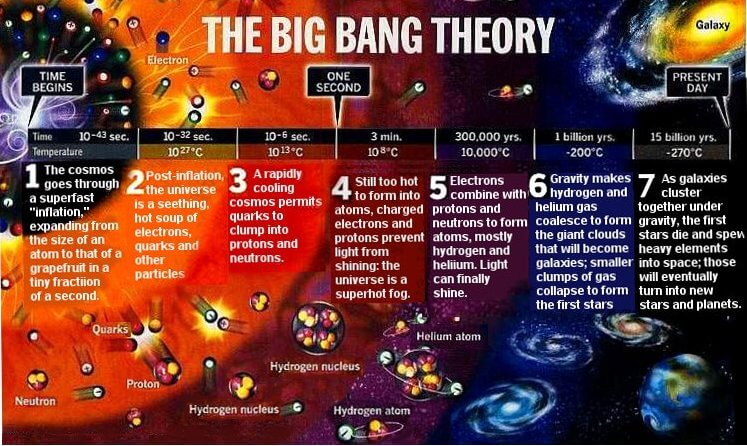
The Big Bang Theory

The Big Bang Theory

TimeT in ◦cEvent
10-43Sec1032The cosmos goes through a superfast “inflation,” expanding from the size of an atom to that of a grapefruit in a tiny fraction of a second.
10-32Sec1027Post-inflation, the universe is a seething, hot soup of electronsquarks and other particles.
10-6 Sec1013A rapidly cooling cosmos permits quarks to clump into protons and neutrons.
3 min108Still too hot to form into atoms, charged electrons and protons prevent light from shining: the universe is a superhot fog.
3,00,000 years10,000Electrons combine with protons and neutrons to form atoms, mostly hydrogen and helium. Light can finally shine.
1 billion years-200Gravity makes hydrogen and helium gas coalesce to form the giant clouds that will become galaxies: smaller clumps of gas collapse to form the first stars.
15 billion years-270As galaxies cluster together under gravity, the first stars die and spew heavy elements into space: those will eventually turn into new stars and planets.
  • The Big Bang theory is the prevailing cosmological model for the birth of the universe.
  • It states that at some moment all of space was contained in a single point of very high-density and high-temperature state from which the universe has been expanding in all directions ever since.
  • Modern measurements place this moment at approximately 13.8 billion years ago.
  • After the initial expansion (inflation), the universe cooled sufficiently to allow the formation of subatomic particles and later simple atoms.
  • The majority of atoms produced by the Big Bang were hydrogen and helium along with trace amounts of lithium and beryllium.
  • Giant clouds of these primordial elements (hydrogen and helium) later coalesced through gravity to form stars and galaxies.
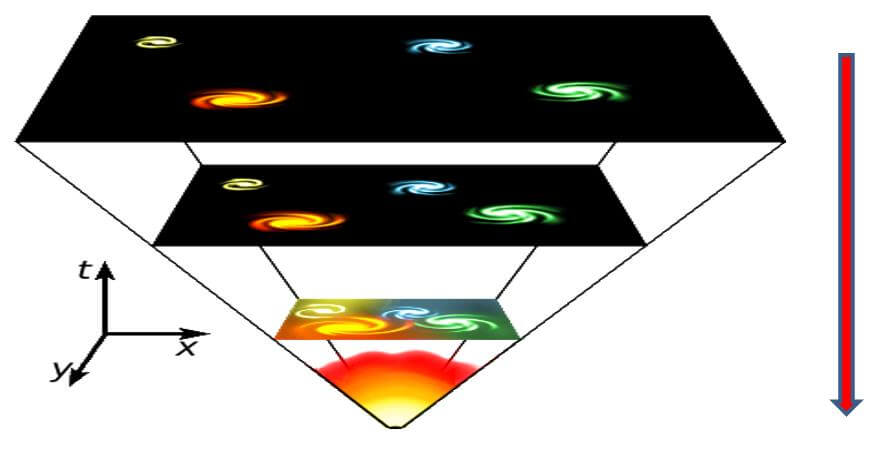
  • According to this theory, the universe, ever since its birth, is expanding in all directions.

universe, ever since its birth, is expanding in all directions

By en:User: Fredrik [Public domain], via Wikimedia Commons

  • In 1964, the cosmic microwave background radiation  was discovered, which was crucial evidence in favour of the Big Bang model.
  • Other evidence such as cosmological redshiftgravitational waves, etc. have added weight to the big bang theory.

Big Crunch

  • At some point of times, the universe would reach a maximum size and then begin to collapse.
  • It would become denser and hotter again, ending with a state similar to that in which it started — a Big Crunch, the death of the universe.

Big Crunch

Doppler-shift or Redshift and Blueshift

  • Redshift and Blueshift describe how light changes as objects in space (such as stars or galaxies) move closer or farther away from us. The concept is key to charting the universe’s expansion.

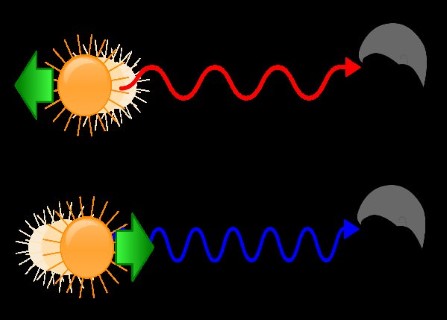
Doppler-shift or Redshift and Blueshift

  • Visible light is a spectrum of colours, which is clear to anyone who has looked at a rainbow.
  • When an object moves away from us (Doppler-shifted to lower frequencies), the light is shifted to the red end of the spectrum, as its wavelengths get longer.
  • If an object moves closer (Doppler-shifted to higher frequencies), the light moves to the blue end of the spectrum, as its wavelength gets shorter.
  • American astronomer Edwin Hubble was the first to describe the redshift phenomenon (galactic redshift) and tie it to an expanding universe (galaxies are drifting apart).
  • Hubble’s law: the farther away galaxies are, the faster they are moving away from Earth ― also known as accelerating the expansion of the universe.

Cosmic microwave background (CMD)

  • With a traditional optical telescope, the space between stars and galaxies is completely dark.
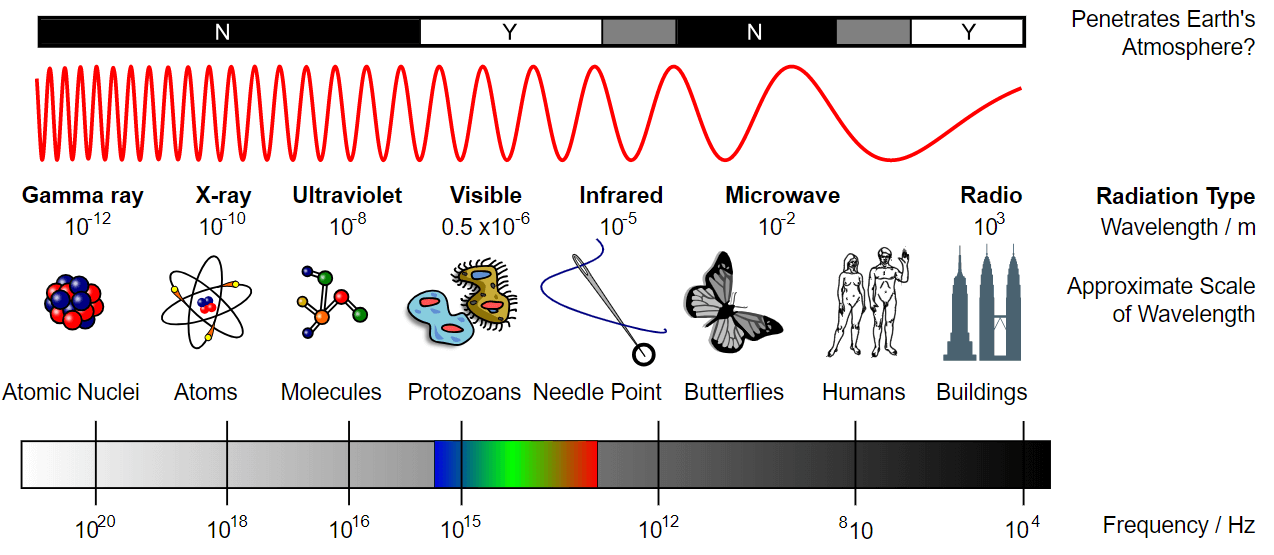
  • However, a sensitive radio telescope shows a faint background glow. This glow is strongest in the microwave region of the radio spectrum, and hence it is called a cosmic microwave background.

Electromagnetic Spectrum

Electromagnetic Spectrum (Inductiveload, via Wikimedia Commons)

  • CMB has gone from high energy photons (gamma photons or X-ray photons) to low microwave photons today due to the redshift from the expanding Universe.
  • CMD, also known as relic radiation is almost the same in all directions and it is not associated with any star, galaxy, or other objects. It is the thermal radiation left over from the “Big Bang”.
  • The CMB is fundamental to observational cosmology because it is the oldest light in the Universe and can be found in all directions.
  • As CMB is the radiation left over from an early stage in the development of the Universe, its discovery is considered a landmark test for the Big Bang model of the Universe.

Accelerating expansion of the universe

  • It is the observation that the expansion of the universe is such that the velocity at which a galaxy is moving away from the observer is continuously increasing with time (Hubble’s law).
  • It implies that the universe will get increasingly colder as matter spreads across in space.
  • The accelerated expansion of the universe is thought to have begun since the universe entered its dark-energy-dominated era roughly 5 billion years ago.
  • The accelerated expansion was discovered in 1998 using distant type Ia supernovae to measure the acceleration.

A type Ia supernova is a type of supernova that occurs in binary systems (two stars orbiting one another) in which one of the stars is a white dwarf. The other star can be anything from a giant star to an even smaller white dwarf.

  • All Type Ia supernovae are thought to have nearly the same maximum brightness when they explode.
  • Such consistency allows them to be used as beacons to measure the rate of expansion of the universe. The weaker the light, the farther away the star is (cosmological redshift).

Dark energy

  • Dark energy is an unknown form of energy which is hypothesised to permeate (spread throughout) all of space, tending to accelerate the expansion of the universe.
Related or similar terminology

Dark matter

  • The velocity of rotation for spiral galaxies depends on the amount of mass contained in them.
  • But the outer arms of the Milky Way are rotating much too fast to be consistent with the amount of matter that we know exists in them.
  • Such fast rotation is possible only when there is more mass, and that extra mass is believed to come from the dark matter.
  • Dark matter is a hypothetical form of matter that is thought to account for approximately 85% of the matter in the universe.
  • Dark energy plus dark matter constitutes 95.1% of the total content of the universe (the rest in the normal matter). In short, we are unsure about what’s there in 95% of the universe!
  • The majority of dark matter is thought to be composed of some as-yet-undiscovered subatomic particles.
  • The name dark matter refers to the fact that it does not appear to interact with observable electromagnetic radiation, such as light.
  • It is thus invisible (or ‘dark’) to the entire electromagnetic spectrum, making it extremely difficult to detect.
  • Dark matter interacts with the rest of the universe only through its gravity (that’s how we know it exists).

Anti-Matter

  • It is hypothesized that every elementary particle in the Universe has a partner particle, known as an ‘antiparticle’.
  • The particle and its antiparticle share many similar characteristics, but many other properties are the exact opposite.
  • The electron, for example, has as its antiparticle the antielectron. They both have the same masses, but they have exactly opposite electrical charges.
  • Most of the human understanding of the antimatter comes from high energy accelerator experiments.
  • When a matter particle meets its antimatter particle, they destroy each other completely (i.e. annihilation), releasing the energy equivalent of their rest masses (following Einstein’s E = mc2).
  • For instance, when an electron meets an antielectron, the two annihilate and produce a burst of light which produces a corresponding energy level equivalent to the masses of the two particles.

Gravitational waves

  • Gravitational waves are 'ripples'in the fabric space-time  caused by some of the most violent and energetic processes in the Universe. 
  • These ripples travel at the speed of light through the Universe, carrying with them information about their origins.
  • Albert Einstein predicted the existence of gravitational waves in 1916 in his general theory of relativity.
  • He observed that massive accelerating objects (such as neutron stars or black holes orbiting each other) would disrupt space-time in such a way that ‘waves’ of distorted space would radiate from the source (like the movement of waves away from a stone thrown into a pond).
  • In 2015, LIGO (The Laser Interferometer Gravitational-Wave Observatory, USA) physically sensed the distortions in spacetime caused by passing gravitational waves generated by two colliding black holes nearly 1.3 billion light-years away!

Gravitational waves

Gravitational waves (NASA)

  • While the processes that generate gravitational waves can be extremely violent and destructive, by the time the waves reach Earth, they are billions of times smaller.

Einstein’s theory of general relativity

  • In 1905, Albert Einstein determined that the laws of physics are the same for all non-accelerating observers and that the speed of light in a vacuum was independent of the motion of all observers.
  • As a result, he found that space and time were interwoven into a single continuum known as space-time.
  • Events that occur at the same time for one observer could occur at different times for another. This was the theory of special relativity.
  • In 1915, Einstein published his theory of general relativity. In it, he determined that massive objects distort space-time, which is felt as gravity.
  • Gravitational lensing and gravitational waves are strong evidence for Einstein’s theory of general relativity.

Gravitational lensing

  • Light around a massive object, such as a black hole, is bent, causing it to act as a lens for the things that lie behind it.


Importance of gravitational waves

  • The gravitational waves can work as sirens to measure the expansion rate of the universe and to understand the origin and the future of the universe.
  • Hubble’s Law: the farther away galaxies are, the faster they are moving away from Earth ― accelerating expansion of the universe).
  • Hubble constant: a unit of measurement that describes the rate at which the universe is expanding.
  • Two parameters that are essential to estimating the Hubble constant are the distance of the stars from Earth and how fast they are moving away from us (their velocity).
  • But to date, the most precise efforts have landed on very different values of the Hubble constant.
  • Scientists have proposed a more accurate and independent way to measure the Hubble constant, using gravitational waves.
  • A flash of light would give an estimate of the system’s velocity (system: neutron stars or black holes orbiting each other), or how fast it is moving away from the Earth.
  • The emitted gravitational waves, if detected on Earth, should provide a precise measurement of the system’s distance.
  • By knowing the system’s velocity and distance, a precise calculation of Hubble constant is possible.

Govt removes AFSPA from parts of Nagaland, Assam and Manipur

Why in News? Recently, AFSPA has been extended for six months in Nagaland. The Centre is considering partial removal of the Arme...